
Are we replaceable? A look at the future of work with AI.
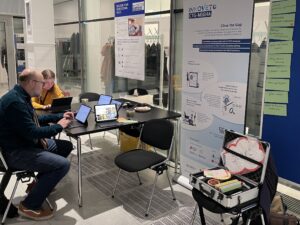
What professional tasks will artificial intelligence (AI) take over in the future? We posed this question to the participants of our Human-AI Interaction Playground.
On March 25 and 26, 2026, the German Hygiene Museum in Dresden became a meeting place for science, art, and technology. This took place as part of the international symposium. "Teaming Up with Generative AI: From Tool Use to Partnership“ We presented the project CtG-MigHa („Close the Gap“), our prototype in an experimental space that invited visitors to participate.
A prototype that makes competencies visible
Our prototype is based on the European classification. ESCO, a standardized language for describing skills, qualifications, and occupations. Participants could enter their educational and professional experiences via an iPad and received suggestions on how their competencies could be translated into ESCO terminology. But our approach went far beyond a simple "translation":
- Reflection on one's own future:Users actively grappled with the question of which of their skills would remain relevant in the long term and which could be supplemented or replaced by AI.
- Conscious profiling:A space was created in which participants could consciously reflect on and further develop their professional profile.
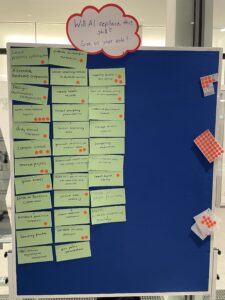 AI as a partner, not as a replacement
The project „"Close the Gap"“ This shows that the future of work depends not only on technological innovations, but also on how we design and use them. When AI is used to uncover hidden talents and empower people, it truly becomes a partner – not only in the work process, but also on the path to it.
A symposium as a creative space
The symposium in Dresden impressively demonstrated that collaboration with AI is no longer a distant vision, but rather a space for shaping and actively developing our own future. Researchers from psychology and computer science met with artists and practitioners to discuss the dynamics of human-AI interaction. It became clear that the most exciting innovations often emerge where disciplines intersect.




 English (UK)
  Deutsch
1 Response